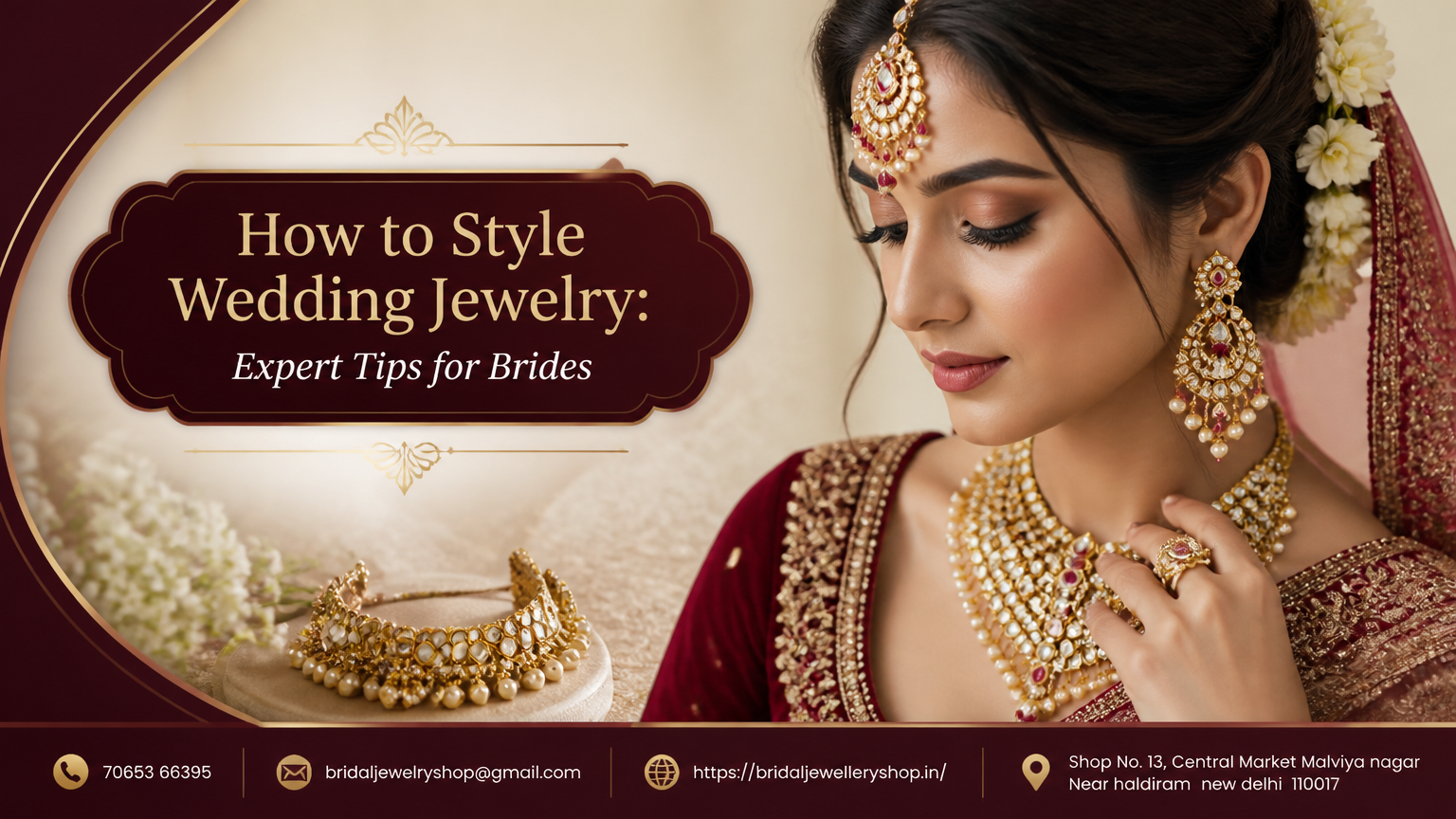
How to Style Wedding Jewelry in 2026: Expert Tips for Brides
Every bride wants her wedding day look to feel unforgettable, and the right jewelry makes that happen. But knowing how to style wedding jewelry properly, what to pair with your neckline, when to skip the necklace, and how to balance tradition with modern trends, can feel overwhelming. Brides today have more options than ever, from heritage kundan-style sets to lab-grown diamond accents and vintage Art Deco pieces. This guide breaks down the styling rules stylists actually follow, the price benchmarks worth knowing, and the matching mistakes that ruin photos. By the end, you will know exactly how to build a bridal jewelry look that feels personal, photograph-ready, and true to your taste.
TL;DR / Quick Answer
Learning how to style wedding jewelry starts with three rules: let the neckline dictate the necklace, balance traditional pieces with modern accents, and prioritize personal fit over trends. Brides in 2026 can choose from kundan-style sets, polki-inspired chokers, lab-grown diamond tennis bracelets, and vintage Art Deco pieces. Working with a styling consultant or trying jewelry with your actual outfit before the wedding remains the single most effective way to avoid mismatched looks.
How to Style Wedding Jewelry? Definition and Etymology
The phrase “how to style wedding jewelry” sounds simple, but it actually covers four distinct decisions: choosing the right pieces, pairing them with your outfit, balancing them with other accessories, and ensuring they suit the occasion. Bridal jewelry styling is the art of coordinating metals, stones, motifs, and proportions so the final look reads as one cohesive statement rather than a collection of separate items.
The word “jewelry” itself comes from the Old French “jouel,” meaning a playful thing or trinket, and the Latin “jocale,” meaning plaything. By the 17th century, the term had evolved to mean personal ornaments, and the modern spelling “jewellery” remains common across India, the UK, and Commonwealth countries. In Indian bridal traditions, however, jewelry carries far more weight than decoration alone. Each piece, from the maang tikka resting on the bride’s hair parting to the nath curving around her nostril, holds cultural, regional, and sometimes even astrological significance.
Understanding this background helps you make confident choices. When you know why a mathapatti trails across the forehead or why a hathphool loops through the fingers, you can decide which traditions to honor and which to modernize. For brides starting their search, working with a knowledgeable retailer makes a measurable difference. About Bridal Jewelry Shop highlights how their Delhi team helps brides decode these traditions in person, with stylists who walk you through the meaning of each piece before you commit.
The 2,500-Year History: From Vedic Courts to Mughal Empires
Kundan-style jewelry traces back over two thousand years, with roots in the royal courts of Rajasthan and the Mughal courts of North India. While no single artisan invented the technique, the craft flourished between the 16th and 19th centuries under Mughal patronage, particularly during the reigns of emperors like Akbar and Jahangir, who patronized court karigars. The craft spread from the Mughal capitals to Rajput kingdoms, where royal families in Jaipur, Bikaner, and Nathdwara adopted and refined it.
By the 18th century, Jaipur had emerged as the leading center for kundan-style craftsmanship, with artisan families passing techniques through generations. The Mughals favored intricate floral and geometric motifs, while Rajput designs leaned toward heavier, sculptural forms inspired by temple architecture. This North Indian heritage is important to remember: kundan-style work is not a South Indian craft, despite occasional misconceptions in modern marketing.
Understanding this history is not just trivia. It explains why authentic kundan-style pieces feel weighty in the hand, why the stones are set in a particular way, and why the work is labor-intensive rather than machine-made. It also helps brides appreciate why certain motifs, like the lotus, the peacock, or the paisley, carry symbolic meaning beyond their visual appeal. When you wear a kundan-style choker, you are wearing a craft form refined over centuries, even when the piece itself is a contemporary, accessible interpretation rather than a museum-grade heirloom.
How Kundan Jewelry Is Made: The 5-Step Craft Process
The traditional kundan-making process follows five distinct stages, and even modern interpretations follow a similar sequence at a smaller scale. Knowing these steps helps you evaluate quality and ask better questions when shopping for bridal jewelry in any price range.
Step one, called Ghaat, is the base structure. The artisan builds a framework, usually from lac, a natural resin, shaped into the desired form. This skeleton determines the final shape of the necklace, earring, or ring. Step two, Khudayi, is the stone-setting stage, where the artisan flattens pure gold foil into thin sheets and uses them to secure each stone in place. Unlike Western prong settings, kundan-style work uses the gold foil itself to hold stones, which is why the technique has such a distinctive look.
Step three, Paadh, involves refining the surface, smoothing the gold work, and ensuring the stones sit flush and secure. Step four is Meenakari, where the reverse side of the piece is enameled in vibrant colors, giving traditional kundan-style work its hidden beauty. Step five, Jadayi, is the final assembly, where multiple elements are connected, polished, and prepared for wear. Each stage can take hours, and a full bridal set can take weeks of skilled labor. For a closer look at how contemporary bridal sets compare to this traditional sequence, Indian ethnic jewelry collection offers a useful starting point.
Kundan vs Polki vs Jadau: Key Differences Explained
Brides often see these three terms used interchangeably, but they describe different techniques, and knowing the difference sharpens your shopping decisions before you commit to a bridal set.
| Feature | Kundan-style | Polki-style | Jadau |
|---|---|---|---|
| Stone used | Glass or quartz | Uncut-diamond-inspired look | Either kundan or polki settings |
| Metal finish | Refined |